How to Harness Design Thinking for Innovative Problem Solving in Your Workplace
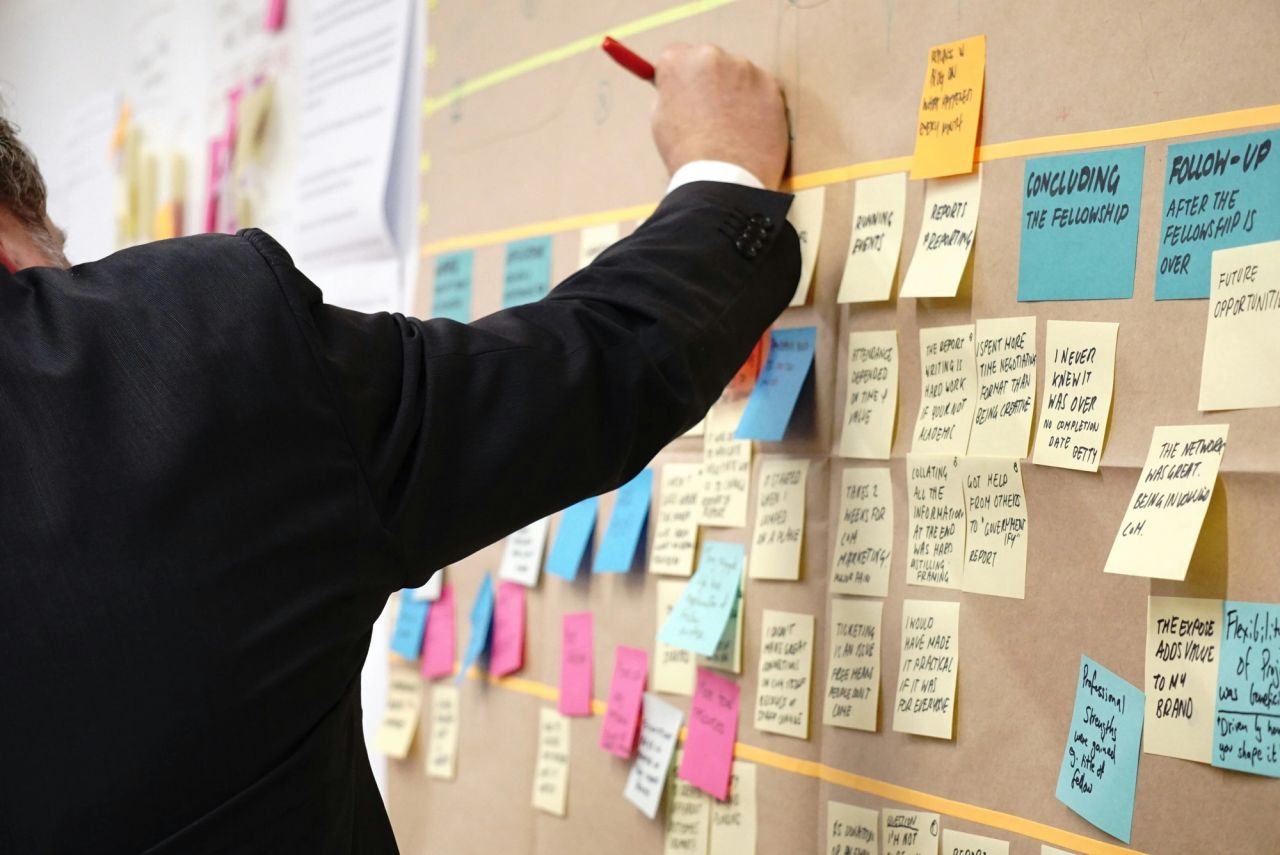
Design Thinking is one of those terms that has spent years trapped inside a single profession. It belongs to designers, the thinking goes: to people with whiteboard walls, coloured markers, and an appetite for Post-its. That framing has done genuine damage. It has kept a powerful problem-solving capability out of reach for the professionals who need it most: leaders navigating ambiguous briefs, operations managers untangling broken workflows, HR practitioners rethinking how people experience their organisations.
The evidence points in a different direction. Design Thinking, understood as a repeatable behavioural capability rather than a designer's toolkit, is one of the highest-leverage skills available to any professional working in a complex, fast-moving environment. It sits at the heart of the Tomorrows Compass Skills Framework as one of twelve measurable capabilities that determine how effectively people perform in conditions of uncertainty, change, and competing demands.
This post examines what Design Thinking actually means as a professional capability, why its relevance has accelerated in the current decade, and how the three underlying behavioural patterns it rests on can be identified, developed, and applied regardless of role or industry.
Design Thinking as a Behavioural Capability, Not a Methodology
The word "methodology" creates the wrong expectations. Methodologies have steps, gates, and deliverables. They live in project management systems and process documentation. When Design Thinking gets framed that way, it becomes another framework to be rolled out in a workshop and then quietly forgotten.
The more accurate framing is capability: a set of repeatable behaviours that can be applied across different contexts, developed through practice, and measured against observable outcomes. This distinction matters because capabilities are portable. A professional who has genuinely internalised Design Thinking as a behavioural pattern does not need a design sprint scheduled in their calendar to use it. They apply it when scoping a new initiative, when a client brief is underdetermined, when a team process has been generating friction for months without anyone quite being able to name why.
Within the Tomorrows Compass framework, Design Thinking belongs to the Strategic Problem Solving cluster alongside Contextual Intelligence, Purposeful Focus, and Dynamic Resourcefulness. The cluster logic is deliberate: these four capabilities work together to enable professionals to move from ambiguous situations to grounded, effective responses. Design Thinking is the mechanism by which problems get reframed and solutions get tested before significant resources are committed.
What Separates Capability from Method
A professional with Design Thinking as a genuine capability exhibits three observable patterns that go beyond following a process:
Empathy-in-action is the disposition to understand problems from the perspective of the people who experience them, before moving toward solutions. This is not a soft skill in the sense of being optional or supplementary. It is the primary mechanism by which professionals avoid solving the wrong problem with high efficiency. Teams that skip this step routinely build technically correct solutions to problems that were never the actual source of friction.
Iteration mindset is the behavioural pattern of treating early attempts as information rather than outputs. Professionals with a strong iteration mindset do not experience early prototypes as failures when they underperform. They experience them as data. This orientation toward progress over perfection is measurably different from perfectionism, which tends to delay action until conditions feel safe enough to proceed.
Problem-reframing is perhaps the most cognitively demanding of the three. It is the capacity to question the problem statement itself before committing to a solution direction. The most common failure mode in complex organisations is not poor execution of a chosen solution. It is confident execution of a solution to a misidentified problem.
Why Design Thinking Capability Carries More Weight Now
Capabilities do not exist in isolation. Their value is always relative to the environment in which they are being deployed. Three structural shifts in the current professional environment have elevated Design Thinking from useful to load-bearing.
Complexity and Ambiguity Are Now Baseline Conditions
The nature of the problems facing organisations has shifted. Many of the challenges that professionals encounter today do not have single correct answers derivable from sufficient analysis. They are what researchers in systems thinking call "wicked problems": problems where the definition of the problem is itself contested, where solving one dimension creates new difficulties in another, and where there is no objective test for whether a solution has worked.
Embracing uncertainty as a professional capability is increasingly necessary precisely because certainty is rarely available before a decision must be made. Design Thinking provides a structured way to act intelligently under those conditions. It does not eliminate uncertainty, but it gives professionals a disciplined process for learning from action rather than waiting for clarity that may never arrive.
The World Economic Forum's core skills research has consistently identified creative problem solving and complex reasoning as among the most critical capabilities for professionals through the current decade. Design Thinking is one of the primary behavioural mechanisms through which those capacities are expressed in practice.
AI Tooling Has Made Rapid Prototyping Accessible
The economic argument for iteration has strengthened significantly. For much of the past two decades, prototyping and testing ideas required meaningful investments of time, resource, and technical capacity. Those costs acted as a brake on iterative approaches. Organisations defaulted to longer planning cycles and larger bets partly because the infrastructure for fast, cheap experimentation was not available to most professionals.
That constraint has shifted materially. Adaptive digital learning and AI-assisted tooling now put rapid prototyping capacity in the hands of individuals and small teams who would previously have required significant support. Documents, interfaces, process maps, communication materials, and analytical frameworks can be produced at a fraction of their previous cost. This does not change the underlying logic of Design Thinking, but it removes a significant barrier to its practical application. The iteration mindset that Design Thinking cultivates is now operationally viable at a scale it was not before.
Customer Experience Has Become a Primary Competitive Surface
Across sectors, the differentiation between organisations increasingly sits at the level of experience rather than product specification. This is not a new observation, but its operational implications have broadened. Experience is no longer the sole concern of customer-facing teams. It shapes how employees engage with internal systems, how partners navigate procurement processes, how candidates form impressions during hiring, and how clients interpret value delivery.
Empathy-in-action, the first of the three core Design Thinking patterns, is the behavioural foundation for any serious attempt to understand and improve experience. Professionals who can move from "how do we fix this process" to "what is it like to be the person who has to use this process" are consistently better positioned to identify the changes that will actually matter versus the changes that look reasonable on a process diagram.
Three Behavioural Patterns in Practice
Abstract descriptions of capabilities only carry so far. The three underlying patterns of Design Thinking become clearer when examined in the context of the kinds of situations professionals encounter regularly.
Empathy-in-Action Across Roles
Consider a scenario in which an HR team is asked to improve the onboarding experience for new hires. A technically focused approach would begin with the process map: what steps exist, where handoffs occur, what documentation is required. A Design Thinking approach begins differently. It asks what the experience of onboarding is actually like from the perspective of a new hire during their first ninety days. What creates confusion? What creates confidence? What signals whether this is a place where a person's contribution will be valued?
The output of that inquiry will often reveal that the most significant friction points are not where the process documentation suggests they would be. They are frequently invisible in process maps because they are experiential rather than procedural.
A regional professional services firm asked to improve retention among early-career staff found, through structured empathy research, that the primary driver of early departure was not compensation or development opportunity. It was the absence of clarity about what good performance looked like in the first six months. The process documentation was complete. The experience of the process was disorienting.
Iteration Mindset and the Cost of Premature Perfection
Perfectionism in professional environments often presents as rigour. It dresses itself in the language of quality and standards. The behavioural cost is delayed action and the accumulation of large bets on untested assumptions.
Iteration mindset inverts that cost structure. Rather than investing heavily in a single fully-formed solution, it directs effort toward a series of faster, lower-cost tests that progressively reduce the uncertainty attached to any given solution direction. Each test generates information. That information either validates the direction, which increases confidence before scaling, or reveals a misalignment early, while correction is still cheap.
This connects directly to Dynamic Resourcefulness as an adjacent capability: the ability to do more with constrained resources. Professionals who treat early versions as tests rather than commitments extract more learning per unit of investment than those who wait until a solution feels complete before exposing it to reality.
Problem-Reframing and the Question Before the Answer
The most consistent error pattern in organisational problem-solving is not poor solution quality. It is confident execution of a solution to a problem that was defined too quickly and without sufficient inquiry.
Purposeful Focus as a companion capability is relevant here: the capacity to direct attention toward the right problems, not simply the most visible ones. Problem-reframing is the specific Design Thinking mechanism by which this happens. It is the practice of questioning the problem statement itself before any solution work begins.
The discipline involved is asking "what is the actual need here" before asking "how do we solve this." Those two questions sound similar. They routinely produce different answers. Teams that skip the first question and go directly to the second have a consistent tendency to produce solutions that are technically sound and functionally incomplete.
Design Thinking in Relation to Adjacent Capabilities
Design Thinking does not operate in isolation. Its practical value is amplified when it functions alongside related capabilities in the Strategic Problem Solving cluster and beyond.
Relational Influence determines whether a professional can bring others into a reframing process. Problem-reframing, however well-executed individually, requires organisational uptake to produce change. Professionals who can make a compelling case for reconsidering a problem definition, without triggering defensive resistance, multiply the leverage of their Design Thinking capability significantly.
Change Agility is the capacity to move effectively when circumstances shift. Design Thinking and Change Agility are mutually reinforcing: the iteration mindset normalises adjustment and reduces the psychological cost of pivoting when new information arrives. Professionals who experience course-correction as failure tend to resist it. Those who experience it as the expected mechanism of progress are faster and less costly to work with in conditions of change.
Embracing Uncertainty and Design Thinking share underlying cognitive territory. Both require the ability to act intelligently before full information is available. The Design Thinking framework provides structure for that action; Embracing Uncertainty provides the dispositional foundation that makes acting under incomplete information feel workable rather than threatening.
Design Thinking does not make complex problems simple. It makes them tractable. The distinction is important: tractable problems can be moved through systematically, even when they cannot be solved definitively. That is the appropriate ambition in most professional contexts.
Developing Design Thinking as a Measurable Capability
Professional development frameworks that treat Design Thinking as a workshop outcome tend to produce limited transfer. The capability develops through deliberate practice in real work contexts, not through exposure to the concept in a training room.
Several behavioural practices build the underlying patterns most directly. The first is developing the habit of asking what the actual need is before moving to solution design. This sounds simple. It runs against strong professional norms that reward decisive action and penalise prolonged inquiry. Building the habit requires intentional effort, particularly in environments that associate speed with competence.
The second is structuring regular, low-cost experiments into existing work. This does not require a formal prototyping process. It requires the practice of testing assumptions before committing to them. A proposal can be tested with one stakeholder before being circulated widely. A new process can be piloted with one team before being standardised. A communication approach can be tried in one channel before being deployed across all of them.
The third is practising the discipline of separating observation from interpretation. Empathy-in-action requires the ability to hear what people are actually describing rather than immediately translating their accounts into the framework already in use. Professionals who interview colleagues, clients, or users and hear only confirmation of their existing view are conducting empathy research in form only.
The Discover behavioural assessment measures Design Thinking as part of the full Tomorrows Compass Skills Framework, alongside the other eleven capabilities in the three skill clusters. This provides a baseline for understanding where Design Thinking sits in relation to other professional capabilities, and where the development investment will produce the most significant return.
The broader argument made by the skills landscape research and the future of work evidence base is consistent: the capabilities that will distinguish high-performing professionals in the current decade are not primarily technical. They are the behavioural capabilities that enable people to navigate complexity, work effectively with and alongside automated systems, and continue to create value in conditions that existing processes and tools were not designed to handle.
Design Thinking, developed as a genuine capability rather than a borrowed methodology, is one of the most direct investments a professional or organisation can make against that challenge.
The illustrative professional scenarios above are composite examples, not specific client outcomes.

About the Author
Tomorrows Compass
Editorial Team
Research-backed perspectives on the skills, mindsets, and capabilities shaping the future of work. Written by the Tomorrows Compass team to help professionals and organisations navigate what comes next with clarity and confidence.
Discover where you stand
About 35 minutes. A personalised report across 12 research-backed capabilities.
Take the Free Assessment